
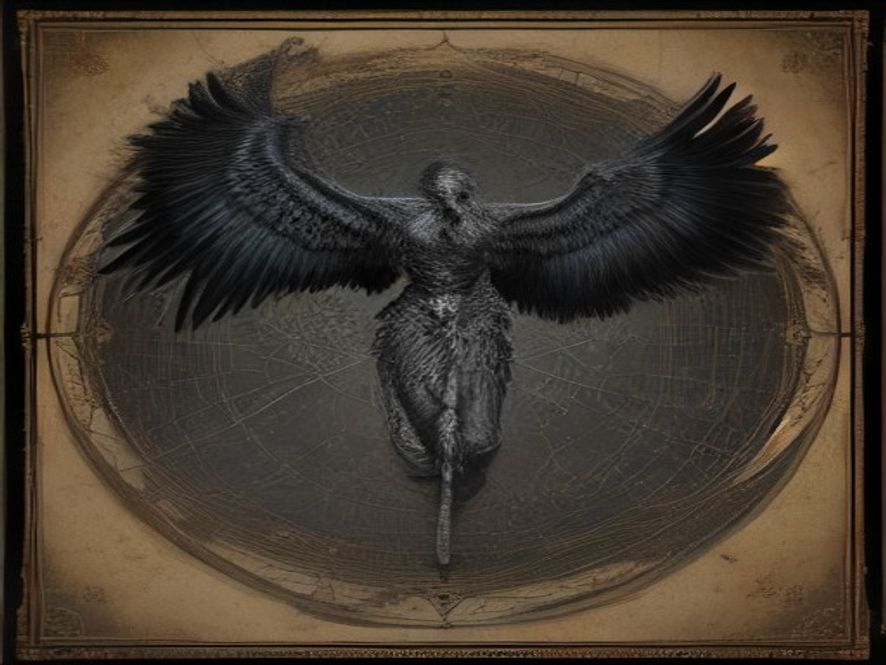

Navigation, Nocturnal Wings, and Uncharted Meridian Lines
London, November 1794. The rain in the East End does not fall so much as it haunts. On nights like this, when the fog rolls heavy off the Thames to choke the gas lamps into submission, Jonathan Sterling would lock the heavy oak door of his high attic library, strike a single beeswax candle, and begin his nocturnal vigil.
To the casual visitor, Sterling was merely an eccentric cartographer who drafted charts of the English Channel for the Admiralty. But to those who knew how to read the shadows, his calculations went far deeper. Jonathan was obsessed with the unseen—the islands omitted from royal surveys, the phantom currents that dragged Spanish galleons into the abyss, and the secret geometry of the stellar canopy.
Relic I: The Cartographer’s Enigma
At the center of Jonathan’s mahogany table sat his prized instrument—a spectacular 12-inch desk globe, its surface boasting deep, parchment-colored oceans and antique typography that seemed to glow in the warm amber light of his hearth.
Jonathan would spin the sphere, his long fingers tracing the path of the Golden Hind or following the trade winds across the Atlantic. He noted that the wind grids were not random; they formed a delicate, mathematical lattice across the parchment-style surface.
Archival Specimen Logs:
- Specimen Dimensions: 12-inch premium diameter (optimal cartography study ratio).
- Stand Configuration: Calibrated heavy metal semi-meridian resting on a robust, charred cedar base.
- Aesthetic Style: 17th-century dual-hemisphere reproduction, baroque wind-roses, and fabled shipping lanes.
- Historical Backstory: Said to be modeled after plates originally commissioned for Andreas Cellarius’s 1660 atlas. Hand-stained with natural walnut extracts to simulate sea-damaged logbook storage.

But to unlock the hidden avenues—the routes leading to islands forgotten by modern sailors—Jonathan needed a biological cipher. He needed the wing of a twilight traveller. On this evening, the seance was complete. Next to his tracking charts lay a flawless, crystal-clear block of optical resin housing a twilight hunter’s intact skeleton.
Relic II: The Midnight Chiroptera
Suspended inside the flawless block, the skeletal structure of a twilight huntress allows a complete, 360-degree study of nature’s delicate engineering. When placed directly over the globe’s wind-rose lattice, the micro-phalanges of the bat’s wing aligned perfectly with the coordinate lines of the sub-polar seas.
Anatomical Specifications:
- Taxonomy Classification: Naturally deceased Pipistrellus abramus skeleton (certified ethical salvage).
- Preservation Block: Optical-grade, UV-stabilized crystal acrylic block. Shatterproof and completely bubble-free.
- Dimensions: Compact pocket size — 3.0″ x 3.0″ x 1.0″ centerpiece.
- Curation Guide: Display under a focused amber candle or LED light. Keep away from intense window sunlight to preserve the bone-dye integrity over decades.

Did Jonathan Sterling find the uncharted islands he sought? In the spring of 1797, he boarded a whaling vessel bound for the sub-polar seas and was never heard from again. However, his attic library remained exactly as he left it. If you spin the sphere in the dead of night, you might still catch the phantom scent of sea salt and hear the beat of silent wings.