

The Navigator and the Nightwatcher: Suspended Flight & Silent Meridians
An excavation of Captain Silas Thorne’s private logbooks (1842), revealing an uncanny method of navigation that used nocturnal wing bones to trace the phantom grids of the South Pacific.
In the damp basement vaults of the late Dr. Alistair Finch, secured within a brass-bound maritime chest of weathered teak, sits a leather-bound logbook dated 1842. The gold leaf on its spine has long since flaked into dust, but the handwriting inside—sharp, slanted, and written with iron-gall ink—remains perfectly legible. It is the personal journal of Captain Silas Thorne, commander of the merchant frigate The Hesperus during her ill-fated crossing of the southern oceanic voids.
According to Captain Thorne’s entries, in the winter of 1842, The Hesperus was caught in a localized atmospheric anomaly. For twelve days, the ship drifted through a silent, violet-tinted fog that choked the sky and rendered magnetic compasses useless—their needles spinning in frantic, erratic circles. Thorne was sailing through a sector rumored to hide “The Devil’s Spit”—a jagged, shifting reef that had claimed dozens of ships and appeared on no charted maps. Without stars or magnetic orientation, the crew prepared for the end.
Yet, they survived. Captain Thorne’s journals reveal that he did not navigate by iron or light, but by a bizarre synthesis of global cartography and biological geometry—two distinct relics that we have recovered from Dr. Finch’s collection, available now for the modern student of natural philosophy.
Relic I: The Cartographer’s Lost Meridian (Replogle 12-inch Globe)
Subject: High-legibility classical terrestrial globe / Antiquarian charting reference
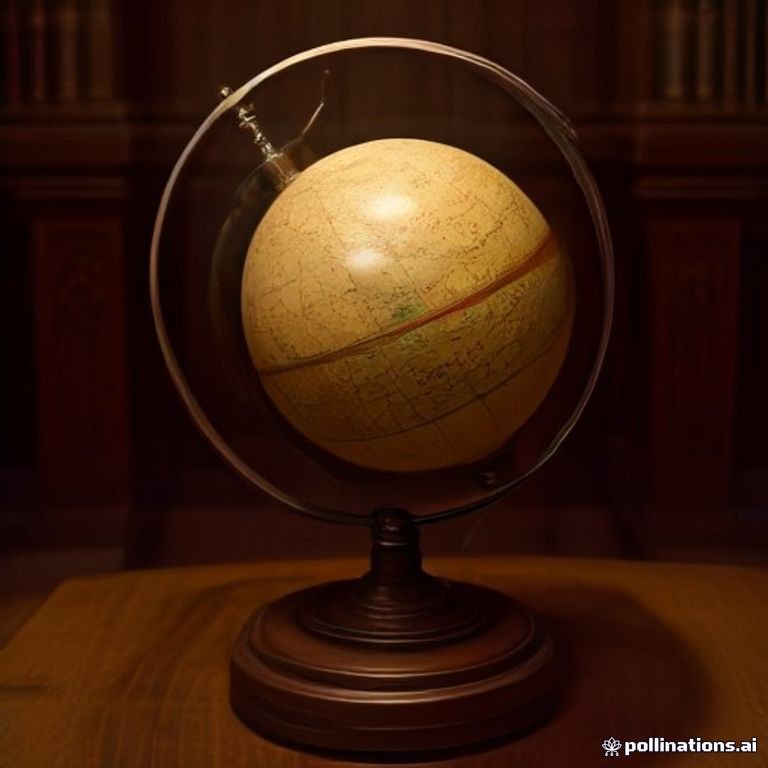
To plan his courses, Thorne relied upon a magnificent 12-inch antique-style globe crafted with exquisite precision. This globe, with its warm, parchment-colored design and rich geopolitical labels, highlighted historic explorer tracks, trade wind grids, and fabled continental caravan routes. It features a heavy mahogany-stained wooden base and a hand-calibrated bronze-finished meridian ring.
During our restoration of Thorne’s ledger, we discovered why this specific globe style was so critical. The parchment-toned surface of the globe was printed using historic plates that retained ancient, non-magnetic wind grid lattices. These grids did not rely on the magnetic poles, but rather tracked the rhythmic physical currents of the planet itself—the breathing pathways of the ocean winds.

Fig 1.1 — The Replogle 12-inch Antique Globe resting on Captain Thorne’s private study desk.
Specimen Archival Files:
- Maker: Replogle Globes Inc. (Renowned for premium-tier global reference).
- Globe Diameter: 12 inches (Optimal academic scale).
- Aesthetic Style: Classic parchment-themed oceans with ancient caravan tracks, wind-roses, and dual-hemisphere routes.
- Base and Stand: Deep walnut-finished heavy solid wood base with die-cast bronze-painted metal semi-meridian.
- Cabinet Dimensions: 16″ Height x 13″ Width x 12″ Depth.
Relic II: The Nocturnal Sentry (Real Bat Skeleton in Resin)
Subject: Elite osteological preparation / Sealed 3D cabinet specimen
Yet to read these ocean winds in the absolute blindness of the fog, Thorne needed more than a map. He needed a biological lens. Deep in his journals, he records placing a singular artifact directly onto the globe’s grid: an authentic real bat skeleton, prepared with meticulous precision and locked within an airtight block of flawless optical-grade resin.
“The flyer of the night does not see with light,” Thorne wrote. “Its bone curves are carved by the very echoes of the wind.” By holding the transparent resin block over the surface of our 12-inch antique globe, Thorne aligned the micro-joints of the bat’s wing-tips (Pipistrellus) with the concentric wind lines mapped upon the paper. When illuminated by a single beeswax candle, the shadow cast by the needle-thin osteological ribs formed a perfect geometric path—a secret coordinate route that guided The Hesperus around the razor edges of “The Devil’s Spit.”

Fig 2.1 — The Pipistrelle skeleton block used to decipher the globe’s non-magnetic wind alignments.
Specimen Archival Files:
- Taxonomy Background: Authentic naturally deceased Pipistrellus bat skeleton (certified ethical salvage).
- Display Medium: Yellowing-resistant, optical-grade acrylic block allowing a complete 360-degree anatomical view.
- Preparation Grade: AAA Osteological specimen detailing delicate ribs, joint connections, and wingspan structures.
- Block Dimensions: 2.9″ Height x 2.9″ Width x 1.0″ Thickness (Heavyweight tabletop block).
- Curation Display: Hermetically sealed against dust and humidity, requiring simple microfiber wipes to retain clarity.